Detect the Big 9 major allergens — including sesame under the FASTER Act — generate a “Contains:” statement with allergens bolded, and apply US allergen terminology automatically from your recipe data.
7-day free trial · no card required · Essentials $19/mo equivalent
US allergen labeling is governed by the Food Allergen Labeling and Consumer Protection Act (FALCPA) and, since the FASTER Act took effect in January 2023, sesame is the ninth major allergen. Getting it right means declaring the correct allergens, using the right US terms, and presenting a clear statement on the label. FoodCore handles all three as FALCPA allergen labeling software built into your kitchen system.
When your Compliance Region is set to United States (or Both), FoodCore detects the Big 9 allergens from your ingredient data — including any compound ingredients and sub-recipes — and produces a “Contains:” statement with the allergens bolded. It applies US labelling terms automatically (Cereals containing gluten → Wheat, Crustaceans → Crustacean Shellfish, Nuts → Tree Nuts) and excludes non-US allergens such as mustard, celery, lupin, sulphites and molluscs from US declarations.
Because allergens live at the ingredient level, you set them up once. Add a new recipe and the major allergens it inherits are already known; change a supplier and the declaration moves with it. For sesame allergen labeling in particular, FoodCore treats sesame as a full major allergen, reflecting the FASTER Act — no manual workaround needed. Read more in our FALCPA Big 9 allergens guide.
This page sits alongside FoodCore’s FDA Nutrition Facts label software and US food labeling software, all driven by the single Compliance Region setting explained on the US compliance software hub.
FoodCore detects and declares all nine on US accounts.
Sesame became the 9th major allergen under the FASTER Act, effective January 2023.
From ingredient data to a compliant US allergen declaration.
Milk, Eggs, Fish, Crustacean Shellfish, Tree Nuts, Peanuts, Wheat, Soybeans and Sesame are detected from your ingredient library across recipes and sub-recipes.
Sesame is handled as a full ninth major allergen, reflecting the FASTER Act effective January 2023 — declared like any other Big 9 allergen.
FoodCore generates a Contains: statement listing the major allergens present, with the allergens bolded for emphasis.
US terms are applied automatically: Cereals containing gluten → Wheat, Crustaceans → Crustacean Shellfish, Nuts → Tree Nuts.
Mustard, celery, lupin, sulphites and molluscs — not US major allergens — are excluded from US declarations so the statement stays accurate.
Compound ingredients and sub-recipes carry their allergens up to the finished product automatically, so nothing hides inside a component.
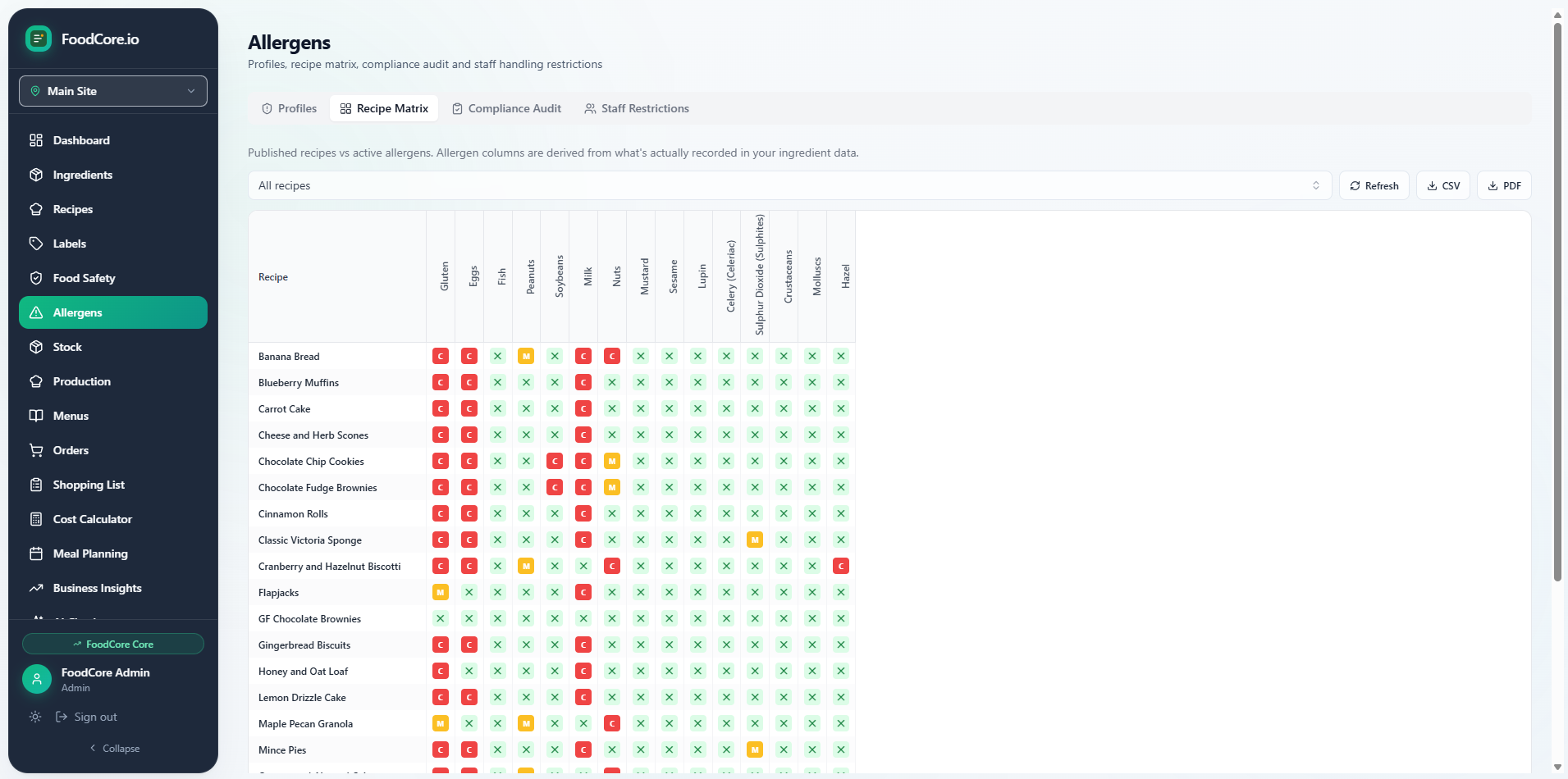
FoodCore’s allergens screen, where allergens are tracked per ingredient.
US producers who need accurate allergen declarations.
Wheat, milk, eggs, tree nuts and sesame are common — FoodCore keeps the Contains: statement correct as recipes change.
Produce consistent Big 9 declarations across every SKU, including sesame, for retail and wholesale buyers.
Use Both mode to map UK 14-allergen data onto US Big 9 declarations from one ingredient library.
Maintain accurate allergen information across large, frequently changing US menus.
Why producers stop tracking allergens in spreadsheets.
The Big 9 are the major food allergens defined under FALCPA and the FASTER Act: Milk, Eggs, Fish, Crustacean Shellfish, Tree Nuts, Peanuts, Wheat, Soybeans and Sesame. Sesame is the 9th, added by the FASTER Act with effect from January 2023.
Yes. Sesame is treated as a full major allergen on US accounts, reflecting the FASTER Act that took effect in January 2023. It is detected from your ingredient data and included in the Contains: statement like the other eight.
On US accounts FoodCore produces a Contains: statement that lists the major allergens present in the product, with the allergens bolded. It is generated from the allergens FoodCore detects across your ingredients and any sub-recipes.
Yes. US labelling terms are applied automatically — for example Cereals containing gluten becomes Wheat, Crustaceans becomes Crustacean Shellfish, and Nuts becomes Tree Nuts. Non-US allergens such as mustard, celery, lupin, sulphites and molluscs are excluded from US declarations.
Yes. Allergens are identified at the ingredient level when you build your ingredient library, then carried through to every recipe automatically, including through compound and sub-recipes. If an ingredient contains a major allergen, every recipe that uses it reflects it without manual rechecking.
Set the Compliance Region to Both and FoodCore keeps both allergen frameworks active — the UK 14 allergens and the US Big 9 — so you can produce the right declaration for each market from the same recipe data.
No. FoodCore detects allergens from your data and formats the declaration, and its region-aware AI assistant reasons under FALCPA and the FASTER Act, but all output is AI-assisted guidance, not legal advice. You remain responsible for verifying your labels.
FoodCore Essentials is $19/mo equivalent (£19) and Core is £55/mo, both with a 7-day free trial and no card required. Sign up at signup.foodcore.io.
Every feature included. No card required. Cancel any time. Essentials from $19/mo equivalent — two plans, one Compliance Region switch.
Start free trial →Questions? Contact us or find us on Instagram.