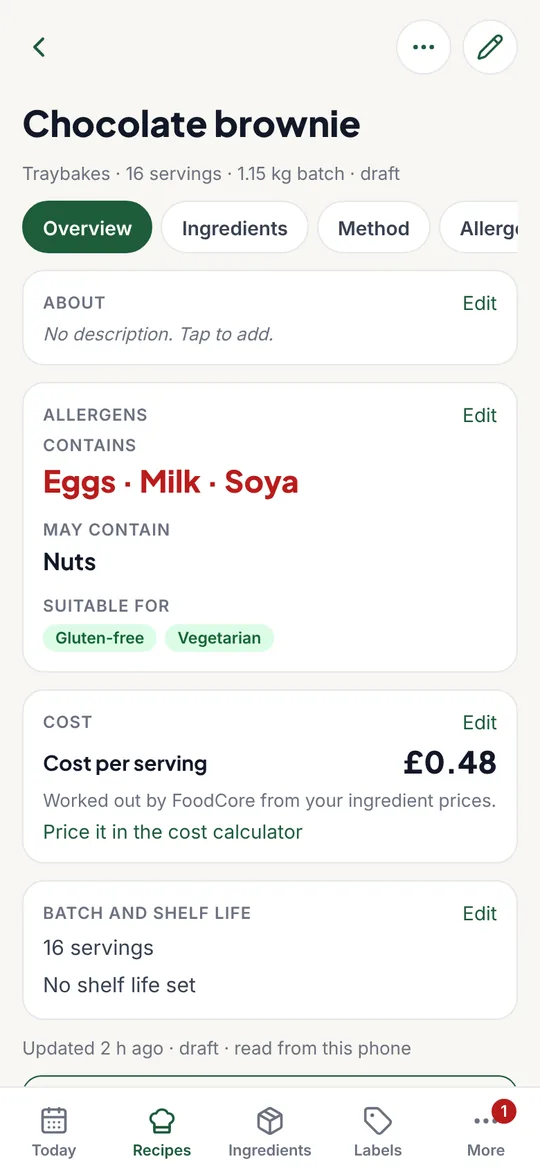
FoodCore costs every dish to the portion from the prices you actually pay, shows the gross profit and food cost % at your selling price, and re-costs your menu when a supplier price changes. Recipe costing is on Growth (£40/mo) or a £5/mo bolt-on on Essentials; menus are on Core (£65/mo) or an £8/mo bolt-on.
7-day free trial with every feature · no card required · no VAT added
Most small kitchens cost their menu once: when the dish goes on. Someone builds a spreadsheet, divides the batch by the portions, picks a price that feels right, and the number is never looked at again. Then butter goes up, the fish supplier changes their pack size, the house sauce gets a better olive oil, and the dish that made a healthy margin in spring is quietly earning far less by autumn. Nobody notices because nothing forces anyone to look.
Menu costing software fixes that by storing the parts instead of the answer. Each ingredient is entered once with its pack price and pack size. Each recipe uses ingredients by quantity and says how many portions it makes. The cost per portion, the food cost percentage and the gross profit are then calculated, not typed, so when an ingredient price changes, every dish that uses it changes with it.
FoodCore is built for small UK food businesses: cafés, small restaurants, caterers, bakeries, delis, meal prep kitchens and market traders, typically with 1 to 15 staff. It is not a till and not accounting software. It is the back-of-house system where your recipes, costs and allergens live, so the cost on your menu and the allergens on your menu come from the same place. If you only need a quick number today, the free recipe cost calculator needs no account.
Food cost programs vary a lot. These are the parts that decide whether your costings stay accurate.
Batch cost and cost per serving are calculated live from your ingredient prices as you build or edit a recipe. Change the number of portions a recipe makes and the cost per portion follows.
Enter a selling price and see the gross margin straight away, or set a target and get a suggested selling price. Use prices excluding VAT so the margin is the money you keep.
Update an ingredient price once, on its own or across many ingredients with bulk editing, and every recipe and sub-recipe using it is re-costed.
A stock, a sauce, a dough or a dressing is costed once and used as an ingredient in other recipes, so a change to the base reaches every dish built on it.
Allow for trim, prep waste and cooking loss, so cost per portion reflects what you actually use rather than what the recipe card assumes.
Group dishes into menus with a printable allergen grid and a prep sheet from any menu (Core, or an £8/mo bolt-on). The costs and allergens come from the same recipes.
From an ingredient list to a costed menu, in the order most kitchens set it up.
For example, a 2kg tub of crème fraîche at £7.40 or a 10kg sack of potatoes at £6.50. FoodCore works out the cost per gram, millilitre or item, so recipes can use any quantity. Allergens are recorded on the ingredient at the same time.
Add ingredients by weight, volume or count, set how many portions the recipe makes, and allow for yield and waste. Sauces, stocks and bases become sub-recipes you can use inside other dishes.
Enter your menu price ex VAT to see gross profit and food cost %, or set the margin you want and let the cost calculator suggest a selling price. Packaging and overheads can be added to the costing too.
With Menus (Core, or an £8/mo bolt-on), group dishes into a menu, print an allergen grid customers can read, and produce a prep sheet for service. Meal planning (Core, or a £5/mo bolt-on) adds a calendar planner with nutrition and cost totals for set menus.
When a supplier price changes, update it once. Every dish re-costs, and supplier price history (Growth and Core) shows how the ingredient has moved. Business Insights (Core, or an £8/mo bolt-on) shows profit per recipe and supplier price movement across your range.
A costing is only as good as the portion it assumes. If the recipe says 10 portions and the kitchen reliably gets 9, every portion costs about 11% more than the menu was priced on. Portion control is partly a software job and partly a kitchen job, and it helps to be clear which is which.
What software does well: it fixes the portion count and the cost per portion in the recipe, scales quantities exactly when you make a bigger or smaller batch, and puts the spec on a prep sheet so everyone makes the same thing. Weigh a real batch, count the portions you actually serve, and put that number in the recipe; it is the single most useful correction you can make.
What it does not do: FoodCore does not connect to scales or check plate weights during service. Consistent portions on the pass still come from your specs, the right ladles and scoops, and training.
Ingredient cost optimisation starts with seeing where the money goes. Sort a dish’s ingredients by cost and the expensive two or three usually account for most of it; that is where a supplier switch, a pack-size change or a small recipe tweak earns its keep. With prices stored, you can test a change on the recipe and see the new cost per portion before you commit, then use supplier price history to check whether a supplier is drifting upwards. The free margin drift calculator shows what an unnoticed price rise costs over a year.
Prices are per month with no VAT added. Annual billing is ten months’ price for twelve months. Bolt-ons let Essentials and Growth add a single feature from a higher plan.
Just costing? Essentials plus the cost calculator bolt-on is £30/month. Costing plus menus? Growth plus the Menus & allergen matrix bolt-on is £48/month. Core at £65/month includes everything above, plus food safety records, team logins and multi-site. See full pricing.
A spreadsheet is fine for ten stable dishes. This is where it stops keeping up.
Better to know before the trial than after it.
Menu costing software works out what every dish on your menu costs to make, per portion, from the prices you pay for ingredients. It shows the food cost percentage and gross profit at your selling price, and recalculates when an ingredient price changes, so the numbers stay current instead of going stale in a spreadsheet.
For a handful of dishes with stable prices, a spreadsheet or a free calculator is enough. Once you have a full menu, sub-recipes such as sauces and stocks, and suppliers whose prices move, a tool that stores your ingredients and recipes works better, because one price change updates every dish that uses it. Look for cost per portion, sub-recipes, yield and waste allowances, gross margin at your selling price, and a free trial so you can test it on your own menu.
The cost calculator (recipe and batch costing, margins and suggested selling prices) is on the Growth plan at £40/month and the Core plan at £65/month, or you can add it to Essentials as a £5/month bolt-on. Menus and the allergen matrix are on Core, or an £8/month bolt-on on Essentials or Growth. Every plan has a 7-day free trial with every feature unlocked and no card required.
Take your selling price excluding any VAT you charge, subtract the cost per portion, and divide the result by the selling price. A dish that costs £3.20 a portion and sells for £10.00 ex VAT makes £6.80 gross profit, which is 68% GP and a 32% food cost. FoodCore shows both figures for every recipe once you enter a selling price.
Yes. Ingredients are stored once with their pack price and pack size, and recipes use them by quantity. Change the price of an ingredient and every recipe and sub-recipe that uses it is re-costed. Growth and Core also keep supplier price history, so you can see how an ingredient’s price has moved over time.
Partly. Each recipe records how many portions it makes, so FoodCore gives you the cost per portion and scales quantities when you change the batch size, and prep sheets show the team what to make. It does not connect to scales or check plate weights during service: keeping portions consistent on the pass is still down to your specs and your team.
Not as a forecasting tool. It shows what your dishes cost today from current ingredient prices, keeps supplier price history on Growth and Core, and Business Insights on Core (or an £8/month bolt-on) shows supplier price movement, waste and profit per recipe. Those make cost trends visible, but FoodCore does not project future costs for you.
Yes. The free recipe cost calculator works out batch cost, cost per serving, food cost percentage and a suggested selling price in your browser, with no account. There is also a free cake pricing calculator that includes packaging, labour and overheads. Neither saves your recipes; that is what the paid cost calculator is for.
FoodCore is built for food businesses with roughly 1 to 15 staff. Core includes team logins and multi-site, but there is no procurement, EDI or enterprise purchasing, and no accredited nutritional analysis. Larger groups needing those are better served by enterprise systems.
Every feature unlocked, no card required. Load your real ingredients and see what each dish really costs.
Start free trial →Questions? Contact us or find us on Instagram.